Shaped by the Sea: How Geography Formed a Nation of Sailors
The Aegean Sea was traditionally known as Archipelagos (in Greek, Αρχιπέλαγος, meaning "chief sea"), although in English this word's meaning has changed to refer to the Aegean Islands and, generally, to any island group. The current Aegean coastline dates back to about 4000 BC. Before that time, at the peak of the last ice age (c. 16,000 BC), sea levels everywhere were 130 metres lower, and there were large, well-watered coastal plains instead of much of the northern Aegean. The seawater level did continue to rise slightly during the classical period, as can be seen by the sunken ancient harbour of Paroikia (Paros) or the Lycian gravesites on the Asia Minor coast.
When they were first occupied, the present-day islands, including Milos with its important obsidian production, were probably still connected to the mainland. The present coastal arrangement appeared c. 7000 BC, with post-ice age sea levels continuing to rise for another 3,000 years after that.
/span>
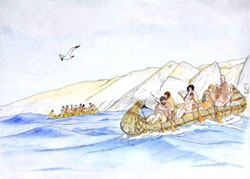 1. Papyrellas
The Papyrella: Stone Age Innovation in the Aegean
The very first vessels used for transport in the Aegean Sea were probably of the “papyrella” type—longboats made from bound reeds that were easily paddled to carry strategic Stone Age material: obsidian stone from Milos to all the adjacent areas. “Half-papyrellas” were still used a century ago in western Greece for coastal fishing (see illustration 1 & 1bis).
The subsequent Bronze Age civilizations of Greece and the Aegean Sea have given rise to the general term Aegean civilization. In ancient times, that sea was the birthplace of two ancient civilizations—the Minoans of Crete and the Mycenaean Civilization (the Achaeans) of the Peloponnese.
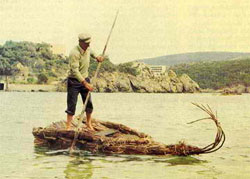 1 bis. Half papyrellas
Harnessing the Etesians: Winds, Harbours, and Ancient Strategy
The history of Aegean ships and maritime trade does not have a concrete starting point; its roots are lost in the depths of history. In a geographical area where no place is more than 90 km away from the sea, Greek populations developed predominantly coastal societies from the Prehistoric Age. In ancient times, navigation was easier than travelling across the rough terrain of the Greek mainland (and to some extent, the coastal areas of Anatolia). The mountainous landscape of the mainland, the limited farming area, and the extended coastline of Greece led people to seafaring. The region's geographical position at the crossroads of ancient sea lanes in the eastern Mediterranean, the multiplicity of islands, and its proximity to other advanced civilizations helped shape the maritime nature of the Greek nation at an early stage.
The northerly “Etesian” winds facilitated trade between Asia Minor and mainland Greece, whereas north-south routes relied on spring and southerly winds. Due to scarce harbors, ships were hauled ashore in sheltered bays. Navigators frequently waited out the strong northerlies at locations like Delos or Aulis (noted in Euripides' play Iphigenia). Strategic military timing was also dictated by these winds, as seen when Philip of Macedon campaigned during the summer to prevent the Athenian navy from sailing north.
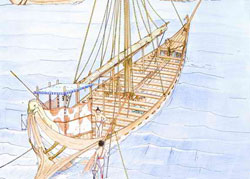
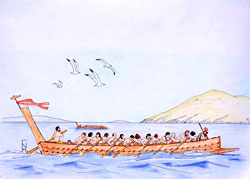 2. Cycladic ship
 3. Fresco from Akrotiri (Santorini) dated around 1600 BC
Echoes of Bronze and Clay: The Design of Ancient Warships
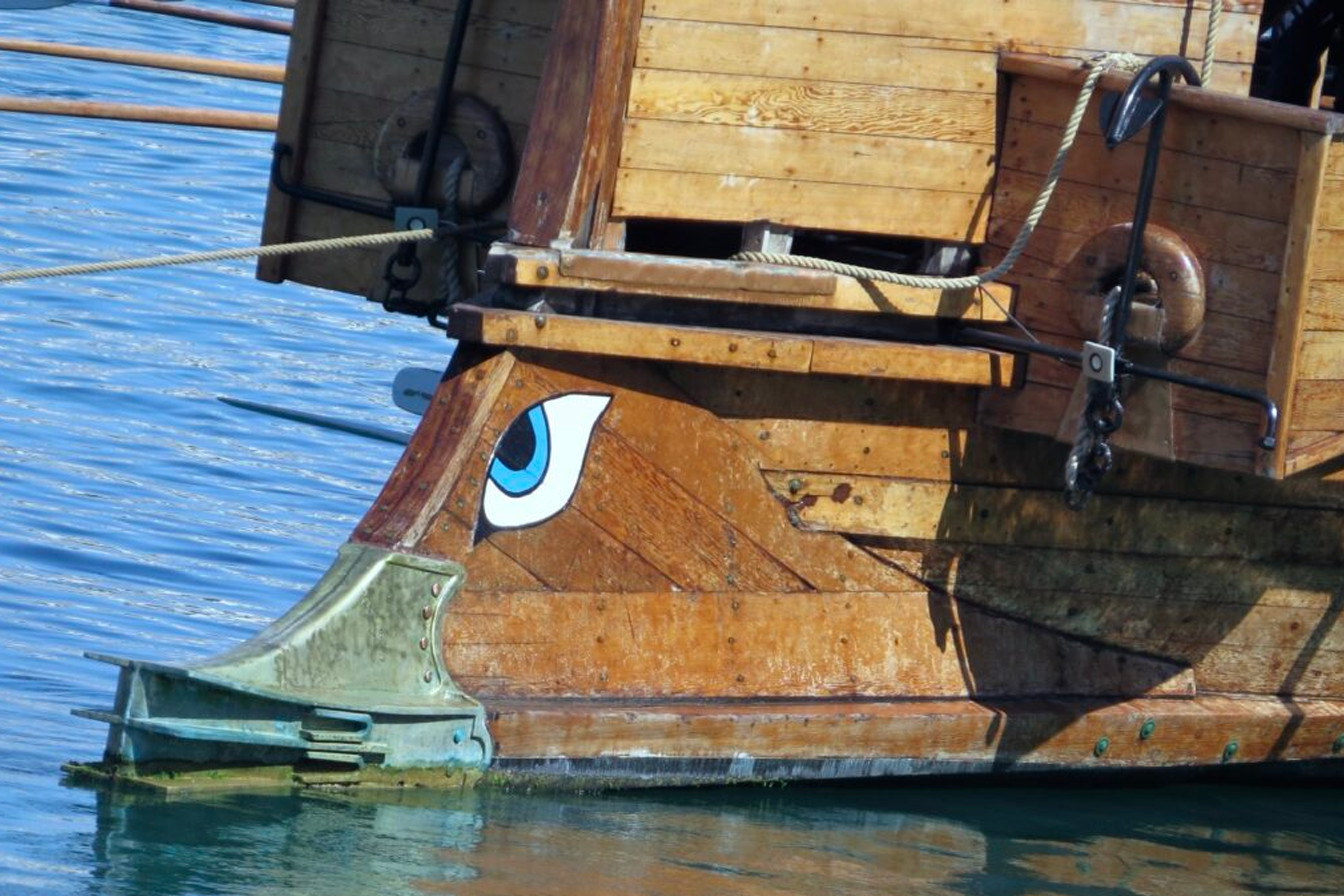
Since the Cycladic period, several pieces of pictorial evidence and shipwrecks have attested to a large development of ships used both as men-of-war and merchantmen. These early Aegean ships were characterized by a lean, long design and a long vertical bow with symbols mounted on top (see illustration 2). On the Greek mainland, ships with the typical curved ram on the bow have been attested since the Middle Helladic period. Because of the intensive commercial trade between the Aegean population and the Near Eastern kingdoms, some of the early Aegean ships show similarities in general shape and design to Egyptian ships of the same period, as well attested in pottery representations and in the famous fresco from Akrotiri on Thera island, dated around 1600 BC (see illustration 3).
Different types of Minoan ships in size and general design are well represented on several seals, pottery, frescoes, and jewellery (see illustrations 4 & 5). Some of the early Achaean ships were similar to Minoan ships, but the later design was still characterized by the typical long, lean design and a long vertical prow with symbols, but with rams and platforms located in the stern and in the high stem. The largest of these ships could accommodate up to 50 oarsmen: the pentekontor. A large sail was also used, probably only when the wind was in the right direction. Sea battles represented on Greek pottery dated during the final phase of the Late Helladic periods seem related to this kind of large or medium-sized Achaean ship, which is also attested in pottery/stone depictions, or askoi coming from Anatolian coastal settlements and islands.
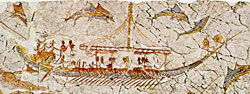 4. Thira (Santorini) ship
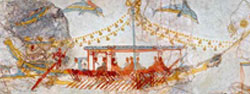 5. Thira (Santorini) ship
The Thera Cataclysm: Fire, Ash, and Tsunami
All this exquisite maritime civilization was to come abruptly to an end. The explosion of the Thera (Santorini) volcano is one of the largest volcanic eruptions in recorded history: the Minoan eruption occurred some 3,600 years ago at the height of the Minoan civilization. The eruption left a large caldera surrounded by volcanic ash deposits hundreds of feet deep and may have led indirectly to the collapse of the Minoan civilization on the island of Crete, 110 km (68 mi) to the south, through a gigantic tsunami. This theory is not, however, supported by chronology, in that the collapse of the Minoan civilization did not occur at the date of the tsunami, but some 90 years later. Rather, there seems to be evidence that it is the massive amount of volcanic ash from the eruption, with high sulfur content, which smothered the Minoan civilization.
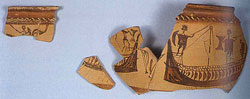 6. Destroying Troy
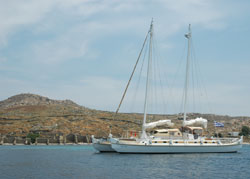 7. Charter yacht Pahi 53 at anchor in Delos harbour (2008)
The Toll of Troy: Metallurgy and Myth in the Age of Iron
As Achaeans succeeded the Minoans, they encountered the rising availability of iron from the Black Sea region, which provided superior tools and weapons. Troy, strategically positioned at the Dardanelles, controlled this vital trade route and imposed heavy tolls on the commerce of this transformative metal.
As the Bronze Age Achaeans replaced the Minoans, they were faced with a major technological challenge: a new metal, iron, started trickling down the trade route from the Black Sea’s southern shores, where iron nodules were collected from dry riverbeds. This new metal greatly increased the efficiency of craftsmen, farmers, and soldiers alike, thanks to the sharper, stronger, and lighter implements it allowed.
Troy controlled this crucial iron trade route at the Dardanelles, exacting high prices. Consequently, the mythic seat of Hephaistos, god of metallurgy, was placed on Lemnos, the primary Greek port for these ships near Troy. Eliminating Troy to secure cheap access to iron and gold from Colchis became inevitable, casting Helen’s elopement as a strategic pretext.
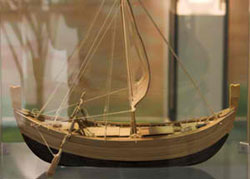 8. Greek trading vessel
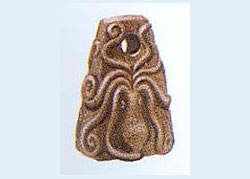 9. Bronze age ceremonial Greek anchor
Delos: The Ancient Singapore of the Mediterranean
At the crossroad of aegean trade lays the small island of Delos (near Mykonos) were from the earliest days, travellers and traders would wait for better weather before continuing their voyages. Investigation of ancient stone huts found on the island indicate that it has been inhabited since the 3rd millennium BC. Thucydides identifies the original inhabitants as piratical Carians who were eventually expelled by King Minos of Crete. By the time of the Odyssey the island was already famous as the birthplace of the twin gods Apollo and Artemis. The excellent harbours and all around protection at Delos (see picture 7 of Archipel Club’s Pahi catamaran at anchor in Delos Hr) turned this small arid speck on the map into something equivalent to modern Singapore, while bearing, as well, enormous religious and cultural significance. Near the Greek sanctuaries, Egyptians, Phoenicians and Jews established their own temples. Massive rain water catchment reservoirs were built to support the ever growing population, while theaters and sports stadia entertained the 30000 estimated guests on the island. Every settlement in the Kyklades Islands with a direct view on Apollo’s Delos Sanctuary was called Apollonia, a place name that has survived today, even after 2000 years of Christianity.
These were times of expansion and the small greek trading vessels started shipping goods between the Eastern civilizations and newly established trading posts all the way to the Western Mediterranean, modern Morocco, Spain and France (see illustration 8 & 9).
The arrival of the Dorians in Greece, pushed numbers of Acheans to move out of the Peloponese and settle in Sicily and southern Italy (a.k.a. Magna Graecia). Later arose the city-states of Athens and Sparta among many others that constituted the Athenian Empire and Hellenic Civilization. Plato described the Greeks living round the Aegean "like frogs around a pond".
The merchant sailing vessels of the classical period carried goods all over the Mediterranean Sea and probably beyond. This was the time when Alexander the Great was advancing his troops to the East and Greek civilization were brought to contact with China via Western Asia and India for the first time. Recollections of Pytheas voyages to northern “Thule” suggest forays into the North Atlantic as well. The workhorse of the Greek trade is exemplified by the “Kyrenia Ship”.
s
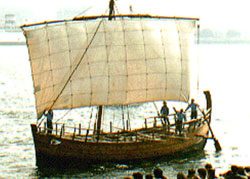 10. Mediterranean trading vessel from around the 3rd century BC
The Kyrenia Ship: A Time Capsule from the Deep
The Kyrenia Ship is a Mediterranean trading vessel from around the 3rd century BC found in 30-meter-deep waters off the coast of Kyrenia on Cyprus in 1967. While ancient shipwrecks have been found all over the Mediterranean, nothing or very little of the ships themselves had survived. The Kyrenia ship was different, however. The unique circumstances that preserved it, owing to its load of amphorae under which a protective layer of sand kept a nearly complete merchant ship from destruction, have resulted in making it, to date, the finest preserved ship of the late Classical period of Greek civilization ever found. After 15 years of excavation and investigation by research teams from 12 countries, the ship was identified to be 14.33 meters long and 4.42 meters wide with a mast of about 11 meters height, weighing about 14 tons (see illustration 10).
404 amphorae were found on the Kyrenia ship and it is known that this wine and olive oil from Samos, Kos and Rhodos were destined for Egypt. She had been built in the shell method of the times with the keel being laid down first then the hull and later the frames, fastened together by copper nails clenched over on the inner side – a medium size vessel with short decks in the bow and stern and an open cargo area between.
The shipbuilders had applied lead sheathing to the outer strakes to protect the hull against shipworm – a technique well-known to the Greeks. Spare sheets of lead were stowed on board for emergency patching. She had a moveable mast with a square sail (10.7 x 6m). Brailing lines (small ropes passing through pulleys used to haul up the sails) were fastened to lead rings. According to the weather or to balance the loads, the sailors could make adjustments by moving the entire mast and sail into different positions along the keel.
 11. Greek war vessel of the iron age
Wood and Oars: The Might of the Athenian Trireme
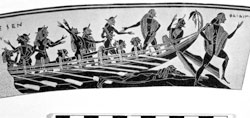
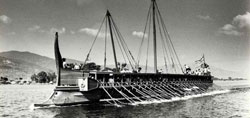
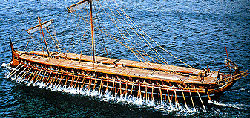
Greek war vessels of the iron age, such as the late pentecontor (50 oarsmen, see illustration 14 from ancient pottery) or the Athenian Triremes were the finest examples of shipbuilding (see pictures 11, 12, 13) of that time and inspired builders well into the next millenia.
However the uniqueness of the Athenian Trireme was its lightness, allowing tremendous maneuvrability and accelerations as a guided, ramming missile, thanks to the efficient rowing sytem of tightly packed rowers. This was possible only because oarsmen were not slaves but free citizen of the City who couldnot afford the (expensive) metal armour & weaponry of the hoplites but still had a duty to defend their homeland. Each Heretes (oarsmen) supplied his own oar and seat. Incidentally, the Trireme carried no soldiers and was intended for ramming only. The cheap, swift and nimble triremes having a clear advantage over cumbersome troop ships and with little means could finish off a mighty adversary before it could land his troops.
As the Greek city states lost political control of their sea to the Romans, a large part of the sea trade of the Roman Empire was still carried out by Greeks, who continued to be involved and play a major role in shipping during the Byzantine era as well, although the lucrative trades were increasingly falling in the hands of Venitians and Genovese.
 12. Athenian Trireme
 13. Athenian Trireme
Breaking Blockades: Trade and Defiance Under Ottoman Rule
During the Ottoman occupation that extended from the mid-15th century until the early 19th century Greece although loosing much of its importance remained active in sea-trading and continued building small and medium size vessels. They expanded their shipping activities and trade towards western Europe in the 16th century, taking advantage from the rapidly increasing need for grain. The restrictions imposed by the Ottomans to regulate the grain trade did not prevent the Greeks from carrying out illicit trade (using russian or british flags and registries) which brought considerable fortunes to them. Later, the Greek maritime merchants increased their influence, as they supplied the Balkans with raw materials, handled goods on behalf of foreigners, distributed the goods to the final markets and controlled the sea trade in the region, assuming the role of shipping agents. Lacking a maritime population, the Turks indentured a great number of Greek seamen in their war and trading fleets.
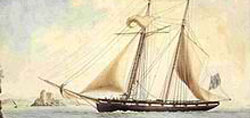
At the end of the 18th century sea-trade had made some Greek islands prosperous. Hydra, Spetsae, Psara, although small and arid had greatly benefited from the seamanship of its inhabitants and had raised an important fleet. Large vessels where ordered abroad, especially in French shipyards, smaller where still built locally (see illustration 14). The Napoleonic Wars and the blockade of the French ports by the English Navy was an important turning point in Modern Greek seafaring. Daring Greek captains repeatedly broke the English blockade and as a result amassed a great wealth. This helped building more, and more ships.
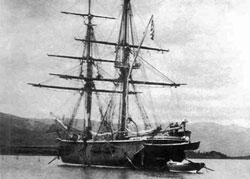
The contribution of the merchant fleets of Hydra, Spetsae and Psara during the independence war of 1821 against the Ottoman rule was decisive (see illustration 19). From the 700 Greek ships that where afloat at the beginning of the uprise, only 150 saw the end of the hostilities. After the establishment of a Greek independent state in 1832, Greek seamen were prompt to adopt modern technologies; first the steam propulsion, then the construction of hulls made not of wooden planks but of riveted iron plates (see illustration 15). Ship-owners, who often were also the captains of their ship, from islands like Chios, Oinousses, Andros and Syros, were trading world-wide since the middle of the 19th century. But the islanders where also involved in numerous other maritime activities; besides fishing an example of lucrative activity was sponge-diving, which for nearly a century was an exclusive activity for the Kalymnians, Symians (see illustration 16) and in a smaller scale Hydriots. The fact that nowadays the merchant fleet of Greece (flying the Greek flag or under other registries) has the largest (18%) tonnage in the world, is not solely due to the shrewdness of the Greek ship-owners, it is mainly the result of a long maritime tradition: that uninterrupted chain, that goes back to the dawn of history.
Sources
http://www2.egeonet.gr/forms/fLemmaBodyExtended.aspx?lemmaID=10594
Tzalas Charis, "Ships and seamanship of the Greeks", 2006
http://www.salimbeti.com/micenei/ships.htm
http://en.wikipedia.org/wiki
 14. 18th century sea-trade vessel
 15. Greek independence war of 1821
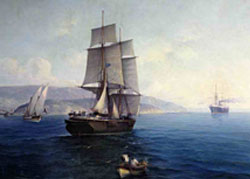 16. Greek sailing ship and steamer by Poulakas